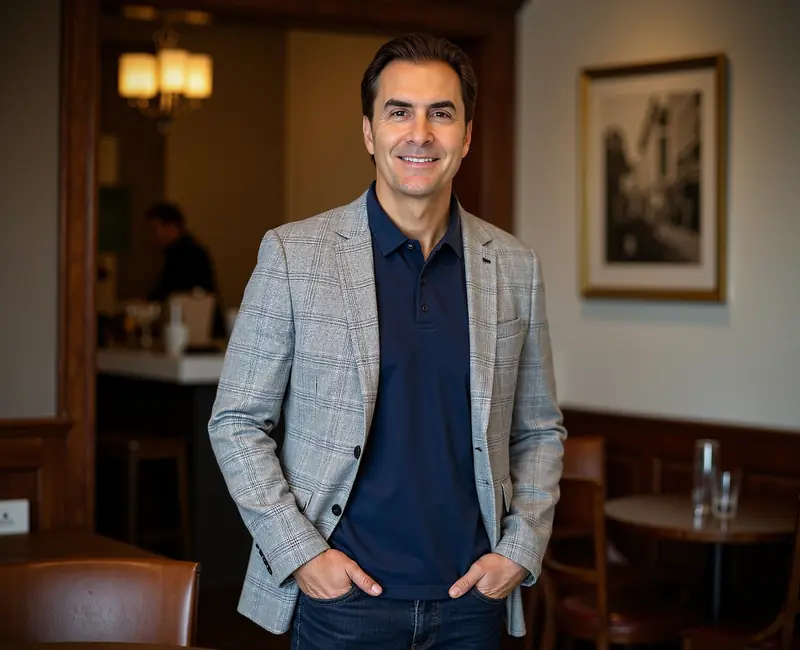
If you run a state agency, a city, a county, or a public university, the AI keynote speaker worth booking is the one who has already sat in the chair when the ransom note hit at 4 a.m. Not the one who has read about it. That is the whole test. Public sector AI is not an idea problem. It is a Monday morning problem, and the person on stage should have solved one before.
I have. Five times as a CIO and CISO. Two hundred plus executive tabletops, many of them for public sector leaders. Daily C-suite advisory across public sector, SLED, commercial, and enterprise. And a Top 5 global ranking in both AI and cybersecurity, which nobody else in the room can claim. That combination is what a governor's cabinet, a city manager, or a public university board actually needs behind a microphone in 2026.
Why public sector is a different keynote
The AI speaker circuit is crowded with futurists. That is fine for a corporate innovation offsite. It is malpractice for a state IT summit.
Public sector leaders operate under three constraints private companies do not face at the same intensity. First, you cannot pick your citizens. Every agency has to serve everyone, which means AI systems have to work for the whole population, not the segment that clicks best. Second, procurement is public, contested, and slow. You cannot ship your way out of an AI mistake. Third, when you get breached or your model misfires, the newspaper writes about it, the legislature investigates, and the auditor never leaves. The stakes are political, not just financial.
A keynote for that room needs an operator who has lived under those rules, not a technologist who has only sold into them.
The threat pattern nobody wants to say out loud
State and local governments were the most attacked public sector target in the world in 2024 and 2025, and the pattern held into 2026. Ransomware crews learned that cities pay faster than large enterprises, because a school district or a 911 system cannot stay dark for six weeks while lawyers negotiate. The pattern I have seen across tabletop exercises is consistent: the attackers use an unpatched edge device or a phished contractor to get in, sit inside the network for weeks, wipe the backups first, then encrypt on a Friday night before a long weekend.
AI is now on both sides of that fight. Attackers use it to write better phishing in the target's local dialect and to speed up reconnaissance inside the network. Defenders use it to compress detection and triage time. Whichever side has the better operator wins, which is almost never the side with the better slide.
That is the message a public sector audience needs to hear. Not "AI is coming." AI is already here, on both benches, and the score is being kept in real budget dollars and real service outages.
What a public sector AI keynote should actually deliver
I frame every SLED keynote around four questions, because these are the questions that come up in every executive tabletop I run for governments:
- What can we say yes to using AI right now that improves a citizen service without adding legal or reputational risk?
- What must we say no to until we have guardrails, and how do we say no without looking like we are behind?
- When our AI system, or a vendor's AI system, causes harm, what is our first hour, first day, and first week?
- When we are breached, and AI is part of the story, how do we brief the governor, the mayor, or the board of regents so they can act instead of freeze?
The answers change by state, agency, and mission. The framework does not. That is what an audience of city managers, agency heads, CISOs, and elected officials can walk out with and use on Tuesday.
The books this keynote is built on
Two of my three books are directly relevant to public sector AI and cybersecurity leadership. Cyber War: One Scenario walks through a critical infrastructure attack in the detail public sector leaders need before it happens to them. A Leader's Playbook for Cyber Insurance covers the coverage, exclusions, and renewal traps that are hitting public entity pools hardest in 2026. Public sector audiences should leave with those two on the shortlist.
What separates this from the futurist AI keynote
Three things.
The seat. I am a five-time CIO and CISO. I have been the one making the call, not the one advising it. When I describe a bad decision under pressure, I am describing a decision I made, not one I coached someone through.
The evidence. Two hundred plus executive tabletops means I speak from patterns across public and private sector, not one anecdote from one client. When I say the plan will not survive the first hour, that is not a punchline. That is data.
The applicability. Every keynote closes with three things that Monday's staff meeting can act on. Not "explore" or "consider." Do. That is the difference between a talk that gets applause and a talk that shows up in the next budget cycle.
Formats that fit public sector events
- State IT summits and technology conferences. 45 to 60 minute keynote plus optional executive tabletop breakout.
- City and county leadership retreats. 60 to 90 minute session with a working scenario the leadership team runs together.
- Public university boards and cabinets. 30 minute board briefing, plus a private tabletop.
- Statewide association meetings, from NASCIO to state CISO groups to municipal leagues. keynote plus roundtable.
Virtual and hybrid formats are available. In-person still wins for the material that matters.
Two questions your board should be asking
Would the AI system your agency stood up last quarter survive an open records request that asked, in plain language, how it makes decisions? If not, that is a governance failure with a shot clock on it.
If your city or agency lost 72 hours to a ransomware event next Friday, does your current plan tell the mayor or the governor what to say to citizens by hour six? If not, that is not a comms problem. That is a leadership problem, and it is solvable before the incident, not during it.
Book the keynote
If you are planning a state, local, or public university event where AI and cybersecurity are on the agenda, the fastest way to see whether the fit is right is to talk. Fees, formats, and available dates are on the AI keynote speaker page and the cybersecurity keynote speaker page. The books are at marklynd.com/books. A contact form and direct booking path are one click from either page.
Bring the operator who has already read the ransom note. That is the keynote your public sector audience remembers, and the one your leadership team can act on.